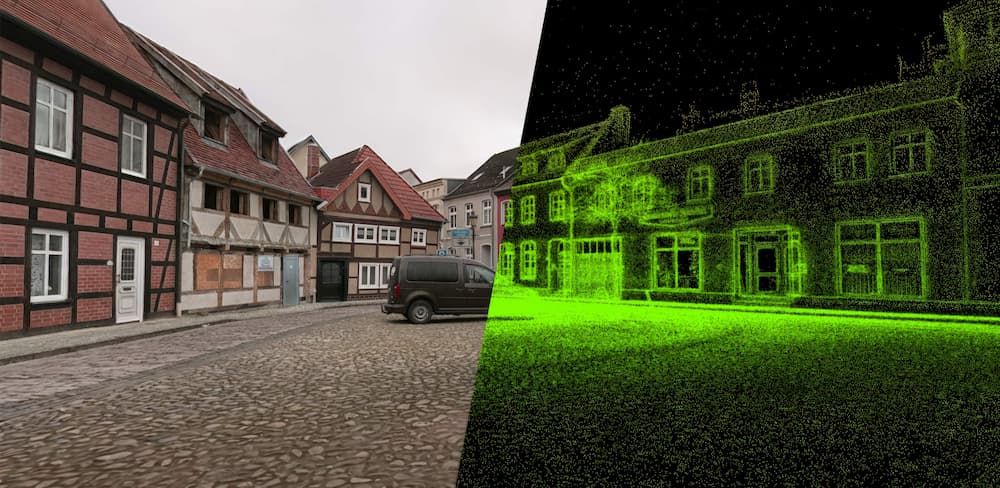
No Single Sensor Tells the Full Story
Every sensor modality is a lens shaped by physics. Optical cameras achieve extraordinary spatial resolution and semantic richness but degrade entirely in darkness, fog, smoke, and dust. Radar penetrates these conditions with ease yet cannot resolve fine structural detail or distinguish surface materials at the granularity required for reliable classification. LiDAR constructs precise three-dimensional geometry of the environment but returns degraded point clouds in precipitation and carries a unit cost that limits deployment density in distributed infrastructure. Thermal imaging reveals heat signatures invisible to all other optical methods yet cannot read surface texture, colour, or printed information. Acoustic and ultrasonic sensors are range-limited and highly directional. Gas detectors are point measurements with no spatial inference capability. Each modality occupies a domain of competence that does not overlap cleanly with the others.
In operational environments where conditions are controlled and predictable, this fragmentation is manageable through careful system design. In the environments our clients actually operate in, it is not. Industrial facilities combine explosive atmospheres, vibration, thermal loading, and electromagnetic interference in the same physical footprint. Field operations run through night, weather, and terrain that defeat any single sensor type. Medical diagnostics require information distributed across modalities with fundamentally different physical bases. Governance and intelligence work demands synthesis across heterogeneous, often degraded data streams at decision-critical speed.
Single-sensor dependence is not a technology limitation awaiting a superior sensor. It is a structural property of physical measurement. The correct engineering response is not to wait for a sensor that does not fail. It is to build systems that reason jointly across multiple imperfect sources, exploiting their complementarity and compensating for their individual failure modes through principled, uncertainty-aware fusion. This is the discipline we have built our deep-tech capability around.
The question facing mission-critical systems is not which sensor to choose. It is how to reason correctly across all of them, including when some are absent, degraded, or actively deceived.
Three Levels. One Consequential Architecture Decision.
Fusion architecture is not a choice made once at project inception. It is a continuous engineering trade-off that must account for latency budgets, compute constraints, sensor heterogeneity, domain shift across deployment environments, and the asymmetric costs of different failure modes. There are three canonical levels at which fusion can occur: at raw data, at extracted features, or at final decisions. Each has a distinct profile of accuracy, brittleness, and operational footprint, and the correct choice is determined by the specific operational context, not by a general preference for any particular level.
Data-level fusion, sometimes called early fusion, operates on raw or minimally processed signals before any modality-specific encoding. It preserves the maximum information available across all modalities and, under ideal conditions, achieves the highest accuracy ceilings. The cost is sensitivity: it requires well-calibrated, temporally synchronised sensor arrays. Miscalibration or asynchrony propagates directly and uncontrollably into the fused representation. It is appropriate where sensor infrastructure is controlled and stable.
Feature-level fusion, the dominant paradigm in current deep learning-based systems, fuses intermediate representations extracted independently from each modality before a shared reasoning stage. Cross-modal attention mechanisms, transformer architectures operating over multi-source token sequences, and unified bird's-eye-view representations all sit in this category. This approach tolerates modest calibration imprecision, supports richer learned interactions between modalities than earlier fusion stages permit, and is the appropriate default for complex perception tasks in dynamic environments. Decision-level fusion combines the outputs of modality-specific models through ensemble, voting, or learned arbitration logic. It is the most resilient to individual sensor dropout, but cross-modal correlation information that would have strengthened inference is irretrievably lost before fusion occurs.
Bird's-Eye-View Projection
Mapping heterogeneous modalities into a shared 3D representation space preserves geometric relationships and enables modality-agnostic reasoning. Optimised BEV pooling reduces inference latency by over 40x versus naive projection while sustaining state-of-the-art detection performance on standard benchmarks.
Asynchronous Stream Alignment
Real-world sensor networks operate at different sampling frequencies with variable and non-deterministic delivery latency. Our temporal alignment pipelines combine global timestamping with adaptive sliding windows to synchronise modalities without introducing artificial lag or requiring hardware-level synchronisation primitives.
Uncertainty is Not Noise. It is Signal.
The most consequential failure mode in fusion systems is not incorrect inference. It is confident incorrect inference. A system that recognises its own uncertainty can defer, escalate, or route to redundant modalities. A system that does not is dangerous in precisely the operating conditions where it matters most: low-light environments, adverse weather, partial occlusion, sensor degradation, and deliberate interference. The ability to know what the system does not know is the property that separates production-grade fusion from demonstration-grade fusion.
Our fusion architectures model uncertainty explicitly throughout the inference pipeline. Aleatoric uncertainty, which is irreducible and arises from sensor noise, quantisation, and environmental stochasticity, is tracked per sensor and per modality through heteroscedastic regression losses calibrated to each sensor's physical noise profile. Epistemic uncertainty, which reflects the limits of the model's learned knowledge and can in principle be reduced with additional training data, is estimated through Bayesian deep learning methods. Monte Carlo dropout at inference time generates an approximate posterior over network weights by running multiple stochastic forward passes through the deployed model. The distribution over outputs is the authoritative inference result. The modal prediction alone is not sufficient for safety-critical decisions.
The mathematical representation of this uncertainty is the covariance matrix across sensor measurements. Kalman filter variants, including the extended Kalman filter for weakly nonlinear systems and the unscented Kalman filter for strongly nonlinear dynamics, propagate covariance estimates through the fusion process, providing the downstream system with a probabilistically grounded posterior distribution over state variables rather than a single point estimate. When the posterior is tight, the system can act. When it is diffuse, it communicates that correctly to the operator and downstream layers, rather than producing false confidence from overfit priors.
Adaptive Probabilistic Fusion Networks
Static fusion architectures that treat sensor weights as fixed hyperparameters fail when reliability shifts dynamically across an operational lifetime or varies spatially across the sensor field. Adaptive Probabilistic Fusion Networks extend Gaussian Mixture Model-based reasoning with dynamic weighting: the contribution from each modality is scaled in real time based on a learned reliability estimate conditioned on the current operating state. This allows the system to suppress a degraded thermal channel during peak heat load, re-weight acoustic sensors during structural resonance, or trust radar over vision in dense precipitation, without operator intervention.
Conformal Prediction under Domain Shift
Standard uncertainty estimates derived during training break down under domain shift: confidence intervals learned in controlled conditions do not transfer to novel deployment environments. Conformal prediction provides a distribution-free, statistically rigorous framework for constructing prediction sets that maintain guaranteed coverage probability even under covariate shift. Applied to multi-sensor fusion, it produces calibrated uncertainty bounds valid not on training data alone but on the out-of-distribution inputs that define real-world deployment, including sensor configurations and environmental conditions not represented during model development.
Bayesian LSTM for Sequential State Estimation
Fusion over time-series sensor data requires architectures that capture temporal dependencies and propagate uncertainty across sequential observations. Bayesian LSTM networks combine long short-term memory's sequential memory with Bayesian weight posteriors that quantify epistemic uncertainty at each inference step. Applied to navigation fusion combining GNSS and inertial measurement units, Bayesian LSTM fusion achieves positioning boundary estimation with error rates below 0.5 percent in hardware-in-the-loop evaluations, while correctly widening confidence intervals during GNSS-denied intervals rather than maintaining artificially narrow bounds from prior clean-signal state.
Designed for the Environments That Matter Most
The value of multi-sensor fusion is not accuracy on benchmark datasets compiled under clean conditions. It is sustained accuracy when the environment degrades, when hardware fails, and when an adversary is actively attempting to defeat the perception system. These are the conditions our clients face, and they are precisely the conditions that expose the inadequacy of systems not designed to handle them explicitly from the first architectural decision.
Sensor dropout is the baseline adversarial condition. A fusion system designed without dropout in mind suffers accuracy degradation disproportionate to the number of modalities lost. The correct architecture treats no modality as mandatory: the system down-weights or excludes a suspect channel, triggers internal self-diagnosis, and continues operating on the remaining streams while communicating appropriate uncertainty escalation to downstream decision layers. Redundancy and fusion are not separate features. They are the same architectural principle, and they cannot be retrofitted to a system not designed with both from the outset.
Adversarial Patch Vulnerability and Countermeasures
Research across current camera-LiDAR fusion systems demonstrates that targeted adversarial patches can reduce mean average precision from above 0.82 to below 0.35 without triggering any sensor-level fault detection. The vulnerability arises not in individual sensor encoders but in the shared fusion mechanism: corrupting one modality at the feature level propagates contamination into the shared fused representation in ways that single-modality defences cannot intercept. The countermeasure is architectural: decoupling modality dependencies at the decoder level, routing inference queries to per-modality or jointly fused decoders based on assessed real-time signal quality rather than fixed configuration assumed at deployment.
Latent-Space Consistency and Fault Detection
Shared low-dimensional latent spaces trained with adversarial alignment objectives provide a natural basis for sensor fault detection. When a sensor stream is corrupted or manipulated, its latent representation becomes inconsistent with the joint posterior implied by the remaining modalities. This inconsistency is detectable as a divergence metric in latent space, enabling the system to flag the suspect channel before its contamination propagates into downstream outputs. Systems built on this principle demonstrate resilience to corruption affecting more than half of active sensor modalities simultaneously, a condition under which architectures without explicit latent consistency checking fail catastrophically and without warning.
Modality Decoupling at Decoder Level
Parallel per-modality decoders with adaptive query routing based on real-time signal quality metrics. Contamination in one modality does not propagate into others through shared intermediate representations.
Degeneracy-Aware Fusion Switching
Online state estimation continuously monitors per-channel quality metrics. When a channel enters a degeneracy condition, the system switches fusion mode automatically, suppressing the unreliable stream until self-diagnosis confirms restoration to operational threshold.
Mixture-of-Experts Adaptive Gating
Per-modality expert networks feed an adaptive gating mechanism that weights contributions based on sample-level informativeness. Sparse MoE variants activate only the subset of experts warranted by the current input, matching dense-fusion accuracy at a fraction of inference cost.
Domain-Shift Augmentation in Training
Robustness to weather, lighting, and environmental conditions is built into the model: clear-condition data is converted to fog, rain, and low-visibility variants during training, ensuring the fusion model has explicitly encountered the failure conditions it will face in deployment.
Analytical Redundancy and Cross-Validation
Overlapping sensor coverage zones enable analytical cross-checking: readings from physically independent sensors covering the same region are reconciled against motion priors and kinematic constraints, exposing contradictions that are often the earliest detectable symptom of a developing hardware fault.
Where We Deploy It
Fusion takes different forms across sectors because the sensor modalities, the failure modes, and the operational stakes are different in each. What remains constant across every deployment is the underlying requirement: a structured, probabilistically grounded output that downstream systems and human operators can act on with calibrated confidence, regardless of what the environment or the hardware does between sensor and decision.
Energy and Oil & Gas Asset Integrity
Industrial infrastructure monitoring integrates vibration spectral data, acoustic emission, thermal imaging, and optical inspection into a unified asset health model that resolves per-asset risk at a spatial granularity enabling targeted maintenance prioritisation rather than blanket scheduled inspection. Acoustic sensors detect early-stage crack propagation and internal flow anomalies invisible to thermal cameras. Thermal imaging identifies electrical hotspots predictive of fault conditions not yet evident in vibration signature. In gas and petrochemical environments, distributed point-source gas sensor networks are fused with atmospheric dispersion modelling and thermal plume detection to provide facility-wide leak characterisation that no single sensor type could achieve independently. The fused output is a continuously updated risk model, not a set of isolated sensor alarms.
Medical AI and Multi-Modal Diagnostics
Clinical diagnostic accuracy depends on synthesising information distributed across modalities with fundamentally different physical bases. MRI resolves soft tissue structure and vascular perfusion. CT provides rapid volumetric anatomical mapping with superior bone contrast and is available in acute settings where MRI is not. Ultrasound delivers real-time functional imaging at the point of care with no ionising radiation. Histopathology provides cellular-level ground truth through invasive acquisition. Fusing these streams requires spatiotemporal registration across modalities acquired at different resolutions and time points, probabilistic reasoning about partial and conflicting findings, and outputs calibrated for both automated downstream inference and direct clinical interpretability. Our systems handle missing modalities by design: a patient pathway that produces MRI and CT but not histology does not degrade silently. It produces the most accurate inference achievable from what is available, with explicit uncertainty bounds on the absent information.
Government and Sovereign Intelligence
Intelligence fusion at government scale involves heterogeneous data streams that differ not only in modality but in collection cadence, provenance confidence, and classification regime. Electro-optical, synthetic aperture radar, signals intelligence, and open-source feeds must be reconciled into a coherent operational picture that identifies both what is present and what is absent, with assessed confidence at each layer. The architectures must operate at speed, tolerate high rates of missing or degraded inputs, and produce outputs with calibrated uncertainty that commanders can act on without requiring full resolution of ambiguity first. Adversarial robustness is not an optional enhancement in this context. It is the primary design constraint from which all other architectural decisions follow.
Engineering AI and Predictive Maintenance
Structural and mechanical asset monitoring across rotating machinery, bridge infrastructure, and civil engineering works combines vibration spectral analysis, acoustic emission, strain gauge arrays, and visual inspection data into a time-series fusion model that detects fatigue accumulation, corrosion propagation, and bearing degradation before they reach severity thresholds visible to any individual sensor. The fusion challenge in engineering contexts is temporal: structural degradation is a slow process measured in months to years, and training signal for failure events is necessarily sparse. Our models are designed to operate reliably in low-event-frequency regimes, with uncertainty estimates that widen correctly as the system extrapolates beyond its calibrated range, rather than producing false confidence from inferences outside the training distribution boundaries.
Autonomous Navigation in Denied Environments
Navigation in GPS-denied, visually impaired, or electromagnetically contested environments requires fusion that maintains localisation without any single anchor modality. Tightly coupled IMU-LiDAR-visual odometry fusion, with Bayesian LSTM sequential estimation for drift correction and uncertainty propagation, provides robust state estimation in tunnels, underground facilities, maritime platforms subject to wave-induced sensor misalignment, and urban canyons where GNSS multipath renders standard positioning unusable. The architecture is designed for degraded-condition realism from the outset: modality dropout is built into the training and evaluation regime, ensuring the deployed system has been validated against the failure modes it will encounter in operation, not merely against the clean conditions it will encounter least often.
Critical Infrastructure and Facilities
Enterprise and government facilities require continuous situational awareness across physical security, environmental monitoring, and operational systems that are architecturally separate but physically correlated. Fusing access control event streams, multi-spectral perimeter cameras, acoustic sensors, environmental monitors, and building management system telemetry into a unified facility intelligence layer enables detection of threat and anomaly patterns that no individual subsystem can identify. The fusion layer operates as a persistent reasoning engine above all building systems, identifying correlated anomaly signatures across physically separated sensor domains that each isolated subsystem would classify as independent non-events below its individual alarm threshold. This is where the value of fusion is most clearly demonstrated: not in improving the accuracy of a single sensor, but in detecting the class of incidents that are invisible to any sensor operating without knowledge of the others.